An HVAC SEO company helps your business show up at the exact moment a homeowner’s furnace quits at 9 p.m. or the AC dies in July. Those people don’t browse. They grab a phone, run a quick search and call the first contractor that looks trustworthy.
If your shop isn’t on that first screen, the call goes to a competitor.
This guide breaks down how HVAC SEO services work, what they cost and how to choose a partner you can trust. It comes from the team at kiwii-it. By the end, you will know:
- What a typical campaign includes
- How Google decides which contractors to show
- A seven-step roadmap you can start using
- Realistic pricing and timelines
- Straight answers to the questions owners ask most
Whether you run a one-truck shop or a multi-crew operation, the sections below will help you decide what to do next.
What Does an HVAC SEO Company Do for Your Business?
The job is simple to describe. Get your company in front of people who need heating or cooling work right now. That covers your website, your Google Business Profile, your reviews and the pages that explain each service you sell.
A good HVAC SEO company also handles the unglamorous work: fixing slow pages, cleaning up listings and tracking which searches turn into booked jobs. Rankings alone don’t pay the bills. Booked jobs do.
| Service | What It Covers | What You Get |
| Local SEO | Google Business Profile, citations, service-area pages | More visibility in the map results |
| On-page SEO | Titles, headings, service pages, internal links | Pages that match what homeowners type |
| Technical SEO | Site speed, mobile layout, indexing, schema | A site Google can crawl and trust |
| Content | Service pages, city pages, maintenance guides | Traffic before the busy season |
| Link building | Chamber, supplier and sponsorship links | Stronger local authority |
| Reporting | Calls, form fills, tracked leads | Clear proof of return |
Why SEO for HVAC Matters More Every Year
Demand isn’t the problem. The Bureau of Labor Statistics counted about 440,900 HVAC technician jobs in 2025 and projects 11 percent growth through 2035. More technicians usually means more competing shops in every metro area.
Customer behavior is shifting too. BrightLocal’s 2026 Local Consumer Review Survey found that 45 percent of consumers now use AI tools to discover local businesses, up from 6 percent the year before. The same research shows that most people read online reviews before they call.
Google also explains how local rankings work. Its Business Profile help page says results rely mainly on relevance, distance and prominence, and that nobody can pay for a better local ranking. That is why steady SEO for HVAC beats shortcuts.
Whitespark’s local ranking survey of industry experts puts Google Business Profile signals at roughly a third of map pack ranking weight. Yet BrightLocal reports that only about 35 percent of small businesses have a profile at all. A complete one is a cheap way to pass neighbors who never set theirs up.
[Image 2: Homeowner calling an HVAC contractor from a phone. Alt text: Homeowner calling a local HVAC contractor]
Signs Your Shop Is Ready for SEO
Most owners reach out after one of these situations shows up.
- Your phone goes quiet in the shoulder seasons and referrals can’t fill the gap
- A competitor with fewer years in business outranks you in your own city
- You pay for ads or lead services and the cost per lead keeps climbing
- Your website hasn’t changed in years and has no pages for individual services
- You have happy customers but only a handful of Google reviews
If two or more sound familiar, SEO will likely pay off.
A 7-Step Roadmap for SEO for HVAC Contractors
You can run this plan yourself or hand it to an HVAC SEO agency. Either way, the order matters.
Step 1: Pick Keywords That Match Real Jobs
Begin with the phrases customers actually type, such as “AC repair near me” or “furnace replacement cost.” Group them by service and by city. Emergency terms bring fast calls. Replacement terms bring bigger tickets.
Step 2: Clean Up Your Google Business Profile
When someone searches “AC repair near me,” the map results show up before most websites do. Your profile is what people see first, so it deserves more attention than most owners give it.
Start with the category. If Google lists you as a general contractor instead of an HVAC contractor, you can miss the exact searches you want. Then walk through the rest of the profile:
- Add each service you actually sell, like duct cleaning or heat pump installation, with a sentence or two about what’s included
- Upload photos of your own trucks, your crew and jobs you’ve finished, since stock images get ignored and customers can tell the difference
- Set your hours carefully, and mark emergency availability if you answer after-hours calls, because a customer with no heat will skip any shop that looks closed
- Reply to reviews yourself, even the bad ones, ideally within a day or two
One more thing trips up a lot of shops. If your name, address or phone number is written differently on Yelp, Facebook and your website, Google gets confused about which details are right. Pick one format and use it everywhere.
Step 3: Build One Page Per Service
Don’t cram AC repair, heat pumps and duct cleaning onto a single page. Give each one its own page with a clear headline, pricing context, short FAQs and a visible call button.
Step 4: Publish Content That Answers Real Questions
Homeowners ask practical questions, so write for them. Good starting topics include:
- How much a new AC unit costs in your area
- Heat pump versus furnace for your climate
- Signs your air conditioner needs repair
- What a tune-up actually includes
Clear, direct answers like these also get picked up by AI answer engines.
Step 5: Add City and Service-Area Pages
If you serve five towns, build five useful pages. Add local detail such as common home types, neighborhoods and permit tips. Pages that only swap the city name look thin to Google.
Step 6: Fix the Technical Basics
Most HVAC searches happen on phones. Pages should load fast, buttons should be easy to tap and the phone number should be click-to-call. Add LocalBusiness schema so search engines read your details correctly. Google’s SEO Starter Guide covers the basics well.
Step 7: Earn Reviews and Local Links
Ask every happy customer for a review the same day. Then go after links from places that already know you: the chamber of commerce, local sponsorships, supplier pages and community news sites.
Plan Your HVAC SEO Around the Seasons
HVAC demand swings hard. Publish and refresh pages four to six weeks before each rush, because Google needs time to index them.
| Season | Focus | Content Ideas |
| Late winter | Cooling prep | AC tune-up offers, replacement guides |
| Spring | Maintenance | Tune-up checklists, indoor air quality |
| Summer | Emergency repair | “AC not cooling” pages, same-day service |
| Fall | Heating prep | Furnace inspection, heat pump guides |
| Winter | Emergency heating | No-heat repair, carbon monoxide safety |
Plumbing and HVAC SEO: Working Both Trades
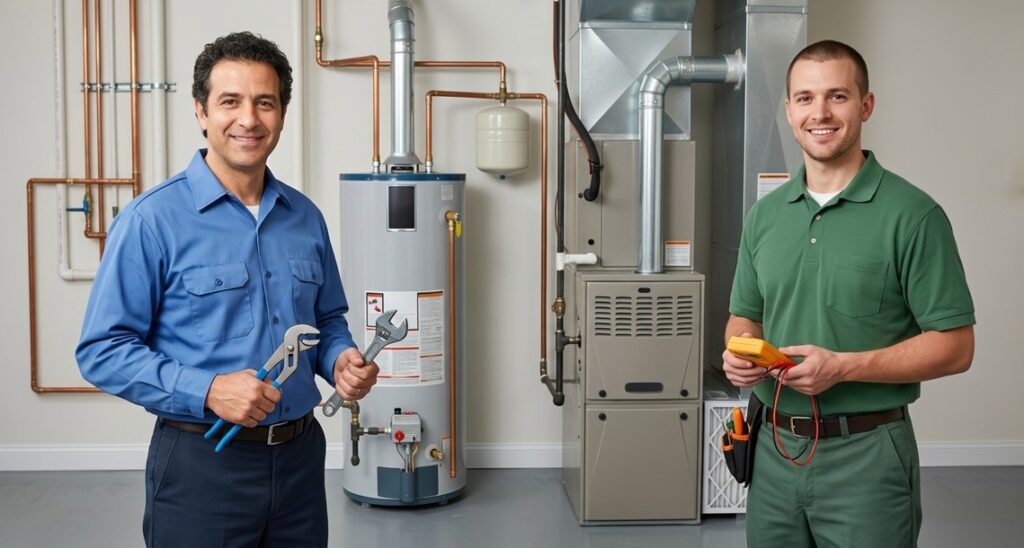
Many contractors sell both services. Plumbing and HVAC SEO works best when each trade gets its own service pages, its own keyword targets and its own FAQs.
Don’t blend them into one vague “home services” page. Searchers want the specific fix they need, and Google wants to see that you cover it in depth.
Shared trust signals can work for both trades, such as license details, reviews and your service area. Link related pages together too. A water heater page can point to your HVAC maintenance plan, and the other way around. That helps customers who need both and keeps average ticket size up.
If you use one Google Business Profile, set the main category for your top revenue trade and add the other as a secondary category.
How Much Do HVAC SEO Services Cost?
Pricing depends on your market, your competition and how many service areas you cover. A strong HVAC SEO company is rarely the cheapest quote you will get, but cheap work usually costs more in the long run.
| Option | Typical Monthly Range | Best For |
| Do it yourself | Software cost plus your time | Very small shops with spare hours |
| Freelancer | $500 – $1,500 | One-truck or new businesses |
| HVAC SEO agency | $1,500 – $5,000 | Growing shops in competitive cities |
| Full service with ads | $5,000+ | Multi-location companies |
These are ballpark figures. Always compare written quotes.
Most campaigns need around four to six months before gains look steady. Local SEO builds slowly, and then it keeps working.
How to Choose the Right HVAC SEO Company
Anyone can claim to sell HVAC SEO services. Ask for proof before you sign. A reliable HVAC SEO company will show real reports, name its tools and explain what it will do each month.
Watch for these red flags:
- A promise of a number-one ranking by a fixed date
- No sample reports or client references
- A long contract with no exit clause
- Ownership of your website or Google profile staying with the agency
- The same generic report sent to every client
Then ask these questions on the first call:
- Who will actually work on my account?
- How do you track calls and booked jobs?
- Who owns the site, the profile and the content if we part ways?
- How often will we meet?
Clear answers here save a lot of frustration later.
Metrics That Show Whether SEO Is Working
Impressions look nice in a report, but they don’t tell you if the phone is ringing. Focus on numbers tied to revenue.
| Metric | Why It Matters | How Often to Check |
| Tracked phone calls | Shows real leads | Weekly |
| Form submissions | Shows online demand | Weekly |
| Map position in your service area | Shows local visibility | Monthly |
| Organic traffic to service pages | Shows content performance | Monthly |
| Review count and rating | Shows trust growth | Monthly |
| Cost per lead | Compares SEO against paid ads | Quarterly |
A Quick Illustrative Example
Picture a four-truck shop in a mid-sized Texas city. An audit shows duplicate listings, one generic “Services” page and 18 reviews.
Over the next six months, the shop builds separate pages for repair, installation and maintenance plans. It fixes its listings, adds city pages for three nearby suburbs and asks every customer for a review. Calls start to climb in month three and keep growing through the summer rush.
This is a hypothetical scenario, not a client result. The point is the pattern: fix the base, add useful pages, collect reviews and let the results build.
Why Work With kiwii-it as Your HVAC SEO Company
As your HVAC SEO company, kiwii-it builds campaigns around booked jobs, not vanity rankings. We start with an audit of your website, your Google profile and your top competitors.
You then get a written plan with clear monthly priorities, call tracking and plain-English reports. You always know what was done, why it was done and what comes next. Send us your website and service area, and we will tell you honestly where you stand.
Frequently Asked Questions
How long does it take an HVAC SEO company to deliver results?
Most shops see early movement in two to three months, such as better map visibility and more profile views. Steady lead growth usually takes four to six months. Competitive cities can take longer.
Is SEO better than Google Ads for HVAC?
They do different jobs. Ads bring calls the day you turn them on and stop when you stop paying. SEO takes longer but keeps bringing calls without a per-click cost. Many shops use ads to cover the gap while SEO builds.
Do I need SEO if most of my jobs come from referrals?
Referrals are great, but people still check you online before calling. Weak reviews or a thin website can lose you a referred customer. SEO also gives you a second source of leads when referrals slow down.
What is the difference between HVAC SEO services and local SEO?
Local SEO focuses on map results and nearby searches. HVAC SEO services cover local SEO plus service pages, content, technical fixes and links. For most contractors, local SEO is the biggest piece.
Can I handle SEO for HVAC myself?
Yes, the basics are doable. Claim your profile, ask for reviews and build service pages. Technical fixes, link building and ongoing reporting take more time, and that is where many owners hand work to an HVAC SEO agency.
Does plumbing and HVAC SEO need separate websites?
No. One site works well if each trade has its own pages and clear navigation. Separate sites only make sense when the two businesses have different brands, owners or service areas.
Wrapping Up
Choosing an HVAC SEO company comes down to trust and proof. Look for a partner who explains the plan in plain language, tracks real calls and lets you own your assets.
Start with the basics. Complete your Google profile, build a page for every service and ask for reviews after every job. Then add content that matches the seasons.
If you want a second opinion on your current setup, the kiwii-it team can review your site and send a written plan. Share your website and the cities you serve, and we will take it from there.