
Business owners across every industry keep asking the same question before they commit to a marketing budget: what is a realistic search engine optimization price for a website that actually needs to compete online in a global market? The honest answer is that the range is huge — anywhere from a few hundred dollars a month for a small local business to tens of thousands a month for a global e-commerce brand.
This guide walks through where most companies actually land, what drives the search engine optimization price up or down, how SEO pricing packages are typically structured, and how AI-driven search is starting to reshape the whole conversation — including specific breakdowns for eCommerce SEO and local SEO, since SEO cost looks very different depending on which of these you’re budgeting for.
What Businesses Typically Spend on SEO Each Month
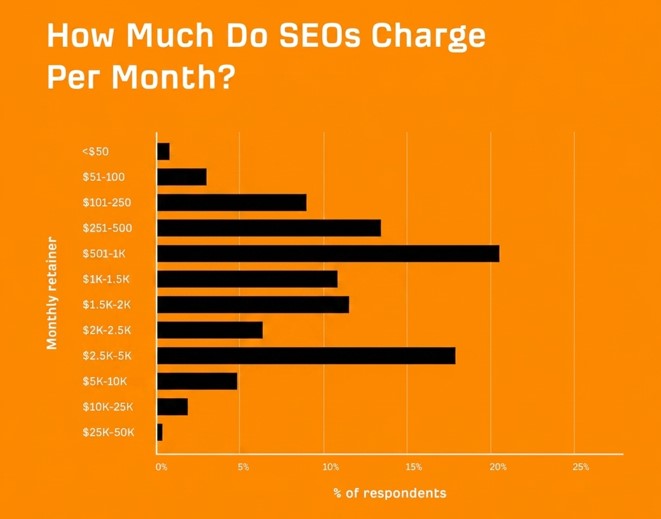
Industry surveys of marketing consistently point to the same rough shape: a wide range from under $500 a month all the way past $50,000, with the bulk of businesses clustering somewhere in the middle. Most companies land somewhere between $500 and $7,500 a month, and within that band, the 1,000–2,500 range tends to be the single most common spot.
A smaller but meaningful slice of the market — often cited around one in ten businesses — spends upward of $20,000 a month, and a handful go beyond $50,000, usually large or fast-scaling companies running multi-market campaigns.
Very few businesses spend less than $500 a month on outside SEO help, since at that level the scope of work an agency or freelancer can realistically deliver becomes quite thin. Most companies also expect their SEO cost to grow rather than shrink year over year, particularly once they start seeing organic traffic and conversions move in the right direction.
It’s worth noting that SEO cost isn’t static even within a single campaign — a business often pays more in the first few months for audits and fixes, then settles into a steadier SEO cost once the foundational work is done.
Why Search Engine Optimization Price Varies So Much Worldwide
If you request quotes from five different providers in five different countries, you’ll almost certainly get five very different numbers. The gap isn’t random — a handful of variables consistently explain most of the spread in SEO cost:
- Current site condition — a brand-new domain with no history needs a different approach than an established site recovering from a manual penalty or an algorithm hit.
- Competition level in the target country — a niche local service business faces far less competition than a global e-commerce brand fighting hundreds of competitors for the same keywords.
- Number of target markets and languages — optimizing for one English-speaking market is a smaller job than optimizing for ten countries across multiple languages and currencies.
- Content and link-building volume required — the number of articles, product pages, and backlinks needed each month scales cost directly.
- Team experience and agency size — a solo freelancer, a boutique agency, and a large enterprise firm all price similar deliverables very differently.
How Businesses Actually Pay for SEO
There isn’t one standard billing structure across the industry — providers mix and match a handful of models depending on the client’s size and goals.
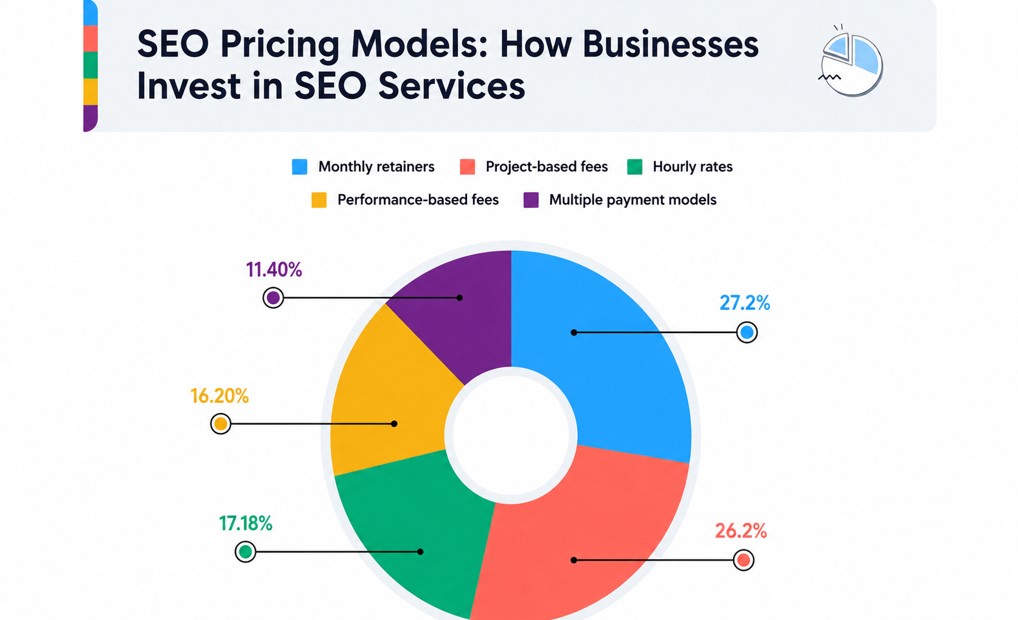
- Monthly retainers are the most common arrangement across almost every budget size, since they suit the ongoing, ever-evolving nature of SEO work.
- Project-based fees run a close second, especially for clearly scoped work like a technical audit, a migration, or a content overhaul with a defined end date — and they’re just as popular as retainers among mid-sized budgets.
- Hourly billing shows up more often at the lower end of the spending scale, typically for one-off consulting, audits, or advisory sessions rather than full execution.
- Performance-based pricing, where fees are tied to ranking or traffic improvements, is far more common among larger budgets — it’s rare below a few thousand dollars a month, since it depends on having enough scale to measure results reliably.
- Some larger companies use a mix of models at once, paying different providers different ways depending on which service each one delivers.
Interestingly, very small budgets often skip formal pricing models altogether — businesses spending under $500 a month are more likely to rely on one-off freelance gigs or marketplace hires than a structured retainer.

What Drives Providers to Set the Price They Do
Beyond the raw dollar figure, a few underlying factors shape almost every quote you’ll receive.
The services included matter more than the label on the package. Buyers tend to place the highest value on keyword research, technical fixes, and competitive analysis — the foundational work that makes everything else possible. Link building, video-specific SEO, and heavy reporting dashboards are often seen as lower priority, particularly by smaller businesses that are more skeptical about measuring their return.
Budget size changes what a business actually wants. Companies on tighter budgets usually care most about the fundamentals — getting the technical basics and keyword targeting right. Mid-sized budgets tend to shift toward strategy competitive research, local SEO, and content optimization become bigger priorities, though many of these businesses still write their own copy in-house rather than paying for content creation.
Larger budgets go all-in on content production, deep technical work, and multi-channel strategy, and tend to care less about narrower services like video SEO.
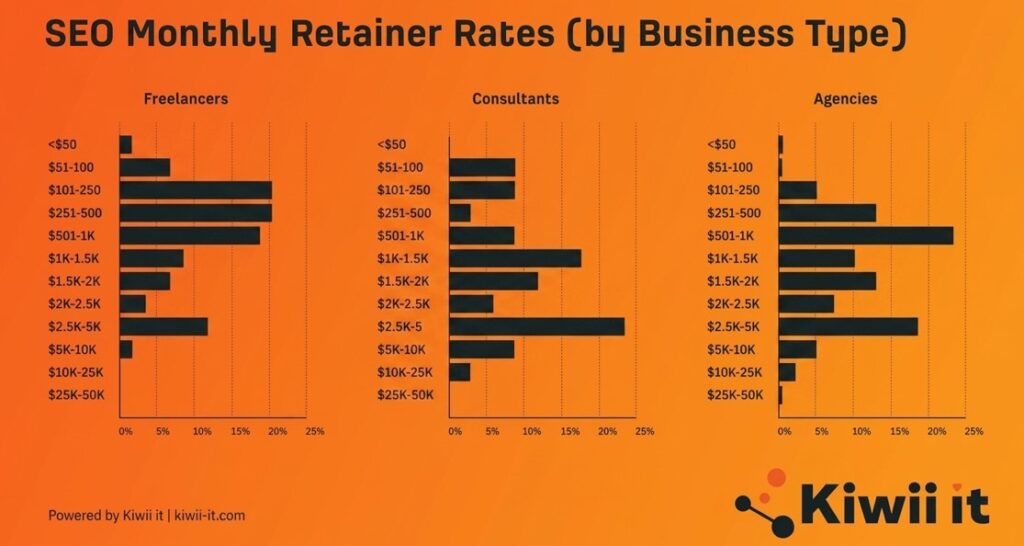
The provider type shapes the price too. Freelancers and independent consultants are typically the most affordable route and are especially common among businesses spending a few thousand dollars a month. Agencies dominate the high end of the market, and once a company’s budget climbs past a certain point, it’s common to see them working with several providers at once rather than a single shop.
SEO Pricing Packages Explained
Most providers organize their offering into a handful of SEO pricing packages rather than quoting every client from scratch, which makes it easier to compare offers once you know what each tier is meant to cover. Below is a general overview based on common global market patterns — treat it as a guideline rather than a fixed price list from any single provider.
| Package Type | Scope of Work | Typical Monthly Investment |
| Starter / Local SEO | On-page fixes, Google Business Profile, 4-5 target keywords | Lower budget |
| Growth Package | Content + technical fixes + link building | Mid-range budget |
| Enterprise / Global Package | Multi-country, multi-language, large content team, PR-level links | Higher budget |
| Hourly Consulting | Audits, strategy sessions, in-house team training | Varies by scope |
| Deliverable Category | What’s Usually Included | What’s Often an Add-On |
| Technical SEO | Site speed, indexing, crawl errors | Full migration or replatforming |
| Content | Blog posts, landing pages | Video scripts, translated content |
| Link Building | Guest posts, outreach | Digital PR campaigns |
| Reporting | Monthly ranking reports | Custom dashboards, executive summaries |
The trickiest part of comparing SEO pricing packages across providers is that the same tier name can mean very different things from one agency to the next — one provider’s “Growth Package” might include weekly content, while another’s includes just two posts a month. Always ask for the exact deliverable count behind any package name rather than assuming the label tells you everything.
eCommerce SEO Pricing: Why Online Stores Pay More
eCommerce SEO tends to sit at the higher end of the search engine optimization price spectrum, and honestly it’s not hard to see why — an online store isn’t optimizing one or two pages, it’s dealing with hundreds or sometimes thousands of product and category pages all at once. A typical engagement in this space usually covers a few things:
- Technical cleanup across large catalogs, since duplicate content and thin product descriptions tend to pile up once you’re dealing with that many pages.
- Category pages that need more frequent attention than a standard service-business landing page would ever require.
- Schema markup for products and reviews, so listings actually stand out with ratings and pricing right in the search results.
- A steady stream of buying-journey content — comparisons, buying guides, real use-case writeups — published regularly instead of as a one-time thing.
Because of this broader scope, eCommerce SEO cost is often quoted separately from a standard SEO package, and it’s common for online stores to pay noticeably more per month than a comparable service-based business with a smaller site footprint.
Local SEO Pricing: The More Affordable End of the Spectrum
At the opposite end, local SEO is usually the most budget-friendly entry point into search engine optimization price, since the scope is naturally narrower — a handful of target keywords, one physical location (or a small number of them), and a Google Business Profile to manage. A typical local SEO package covers:
- Google Business Profile setup and ongoing optimization.
- NAP (name, address, phone) consistency across directories and citation sites.
- A small set of geo-targeted keywords rather than a broad national or international list.
- Basic on-page fixes and a handful of location-specific landing pages.
Because local SEO doesn’t usually require the same volume of content or link building as a national or global campaign, it’s the package where businesses most often see a lower monthly SEO cost relative to the results they get — which is part of why it’s such a common starting point for small, single-location businesses.
Why Companies Bring in Outside SEO Help in the First Place
It’s worth understanding why businesses hire external SEO support at all, because the reason often shapes what kind of provider — and pricing model — makes sense.
- Most commonly, a business simply doesn’t have the in-house expertise to do the work properly.
- Some need to get a campaign moving fast and don’t have time to build a team from scratch.
- Others have the knowledge but not the staff hours to execute consistently.
- A fair number bring in outside help specifically to cut costs compared to hiring a full internal team.
- And a smaller group turns to outside providers after being unhappy with results their internal team produced.
Smaller businesses tend to hire out mainly due to limited in-house skills and resources, while larger companies with bigger budgets are more likely to bring in outside help when they need a campaign launched on a tight timeline.
A Real-World Case Study
Take a mid-sized DTC home goods brand that sells internationally and decided to run a six-month SEO push across both English and European markets. Traffic was basically flat going in, and the site had a few obvious problems — pages loaded slowly, category descriptions were thin, and there wasn’t really a content plan to speak of.
The first couple of months went into fixing the technical side: a full audit, cleaning up Core Web Vitals, and rewriting the category pages so each target region actually had useful product information instead of generic filler.
Once that groundwork was done, the team started publishing two in-depth articles a week — buying guides, comparisons, real use-case content — and put some effort into localizing things for their two biggest European markets. Six months in, organic traffic had nearly tripled, and five commercial-intent keywords were sitting on page one across several countries.
Breaking down the spend, the early technical work required a larger share of the budget, while content, localization, and outreach costs stayed relatively steady in the following months. The case shows why judging results from a single month is misleading — a fair read of return on investment usually needs at least four to six months of data, and international campaigns often need slightly longer timelines than single-market ones.
How Satisfaction and ROI Actually Track With Spending
Most businesses that invest in SEO end up satisfied with what they get back for it — dissatisfaction is genuinely rare across the market as a whole. That said, satisfaction isn’t evenly distributed across budget sizes.
Companies spending at the higher end of the market tend to report the strongest results, likely because bigger budgets buy more comprehensive strategy and closer account management. Mid-tier spending produces more mixed feelings — plenty of businesses in this range feel their SEO delivered a fair but not spectacular return.
It’s actually the smaller end of the market, businesses spending on the lower side, where a meaningful share feels their SEO investment wasn’t really worth the price — usually a sign the scope was too thin to move the needle or expectations weren’t set realistically from the start.
The metrics that matter most to buyers are organic traffic and conversions, followed by keyword rankings and general visibility and authority gains.

How AEO, GEO, and LLM SEO Are Reshaping Strategy and Cost Globally
In 2026, visibility inside AI tools like ChatGPT, Gemini, Perplexity, and Claude matters just as much as traditional Google rankings for many global brands. This is where AEO (Answer Engine Optimization) and GEO (Generative Engine Optimization) come in, and both are starting to influence overall search engine optimization price structures.
AEO — Answer Engine Optimization The goal here is to answer a user’s question clearly and directly, so an AI system can easily pull that answer from your page. This means adding well-structured FAQ sections, clear heading hierarchies, and placing the core answer near the top of the content rather than burying it several paragraphs in.
GEO — Generative Engine Optimization GEO focuses on getting AI models to actually reference or cite your content when generating answers to users. That usually requires building topical authority — publishing multiple in-depth pieces on the same subject and making sure key entities and concepts are stated clearly rather than implied, so an AI model has no ambiguity about what your business does.
LLM SEO This layer is about making sure large language models can understand what your site is about with minimal ambiguity. Writing in plain, direct language, covering related semantic concepts, and including concrete real-world examples in every section all help models parse and trust your content faster.
Because of these shifts, a lot of agencies are now breaking out AI-visibility audits or LLM indexing analysis as their own line item, which can end up changing the total quote quite a bit. It’s worth just asking directly whether AEO and GEO work are part of the deal before you sign anything, since this has genuinely become something you need to factor into how you compare global search engine optimization price in 2026.

Ways to Bring Your SEO Costs Down Without Cutting Corners
If your budget is tight, there are a few genuine ways to reduce what you’re paying an outside provider without gutting the strategy itself.
- Handle preliminary keyword research yourself — business owners often already know the language their own customers search in, and free tools can get you most of the way there before a provider refines it.
- Write your own content if you have the in-house capacity, letting the provider focus on strategy and direction rather than production.
- Take on simpler local SEO tasks yourself, like managing your Google Business Profile, once a provider walks you through the basics.
That said, don’t try to strip out everything — some parts of SEO genuinely need expert judgment, and cutting too deep tends to show up in weaker results later.
A Practical Checklist for Setting Your Global Budget
Before agreeing to any number, it helps to work through the following steps.
- Audit your current technical health — get a clear picture of site speed, indexing status, and backlink profile before comparing any quotes.
- Study your competitors in each target country — different markets often have different levels of competition for the same product category.
- Get everything in writing before you commit — a vague “monthly retainer” line item tells you nothing, so push for an actual list of what you’re getting.
- Nail down how they’ll keep you in the loop — what the reports actually look like, how often they land in your inbox, all of that should be settled before you sign.
- If a provider is guaranteeing top rankings fast, walk away — good SEO takes time, and anyone promising otherwise is either inexperienced or not being straight with you.
Frequently Asked Questions
How much does SEO actually cost?
It ranges from a few hundred dollars a month for a small local campaign to well over $50,000 a month for a large, multi-market brand. Most businesses land somewhere between $500 and $7,500 a month.
What should a small business budget for SEO in a global market?
Honestly, it comes down to how many countries and languages you’re dealing with. Sticking to one market keeps costs down; go multi-country with localization and the number climbs pretty quickly.
Can you get good results on a lower budget?
You can, but keep your expectations in check — three to six months is normal before things really show, and competitive international markets can take even longer.
Do AEO and GEO add extra cost to a standard SEO package?
A lot of agencies fold this into what they already offer these days, so don’t just assume — ask them straight up whether it’s included.
Is a monthly retainer better than project-based pricing?
Not really a matter of better or worse — it’s about fit. Retainers work for ongoing growth, while project-based pricing makes more sense for something with a clear finish line, like a migration or a one-time cleanup.
How long does it take to see a return on SEO investment?
You’ll usually notice some movement by month three or four, but the results that actually matter tend to show up somewhere between month six and twelve.
Should pricing differ for e-commerce versus service-based websites?
Pretty much, yeah. E-commerce sites tend to need more ongoing content and technical attention just because of how many product pages are involved, while a service business can usually get by with a tighter, more focused scope.
What’s a red flag when comparing SEO proposals?
Watch out for anything vague — no real reporting plan, promises of guaranteed rankings by a certain date, or a price that just seems too low for the amount of work being described.
Does hiring an in-house SEO specialist cost less than an agency?
Depends on how big the operation is. A full-time hire can pay off for a large, ongoing program, but an agency usually makes more sense if you need a wider range of skills without committing to a full-time salary.
Is it worth paying more for an agency with AI-search experience?
If AI-driven discovery already sends meaningful traffic to your industry, agencies with real AEO and GEO experience can be worth the premium, since this is still a newer skill set many providers haven’t fully developed.
Final Thoughts
At the end of the day, the right search engine optimization price for your business really comes down to your goals, how competitive things are in each market you’re going after, and how patient you’re willing to be before you start seeing real numbers move. Forget chasing one “right” figure — you’re better off weighing everything covered here and landing on a range that actually makes sense for your business and where you want it to go globally.
And as AEO, GEO, and LLM SEO keep changing how AI systems pull and surface content, pricing structures across the industry will keep shifting too — which is exactly why staying informed and picking the right partner matters a lot more than just hunting for the cheapest quote.